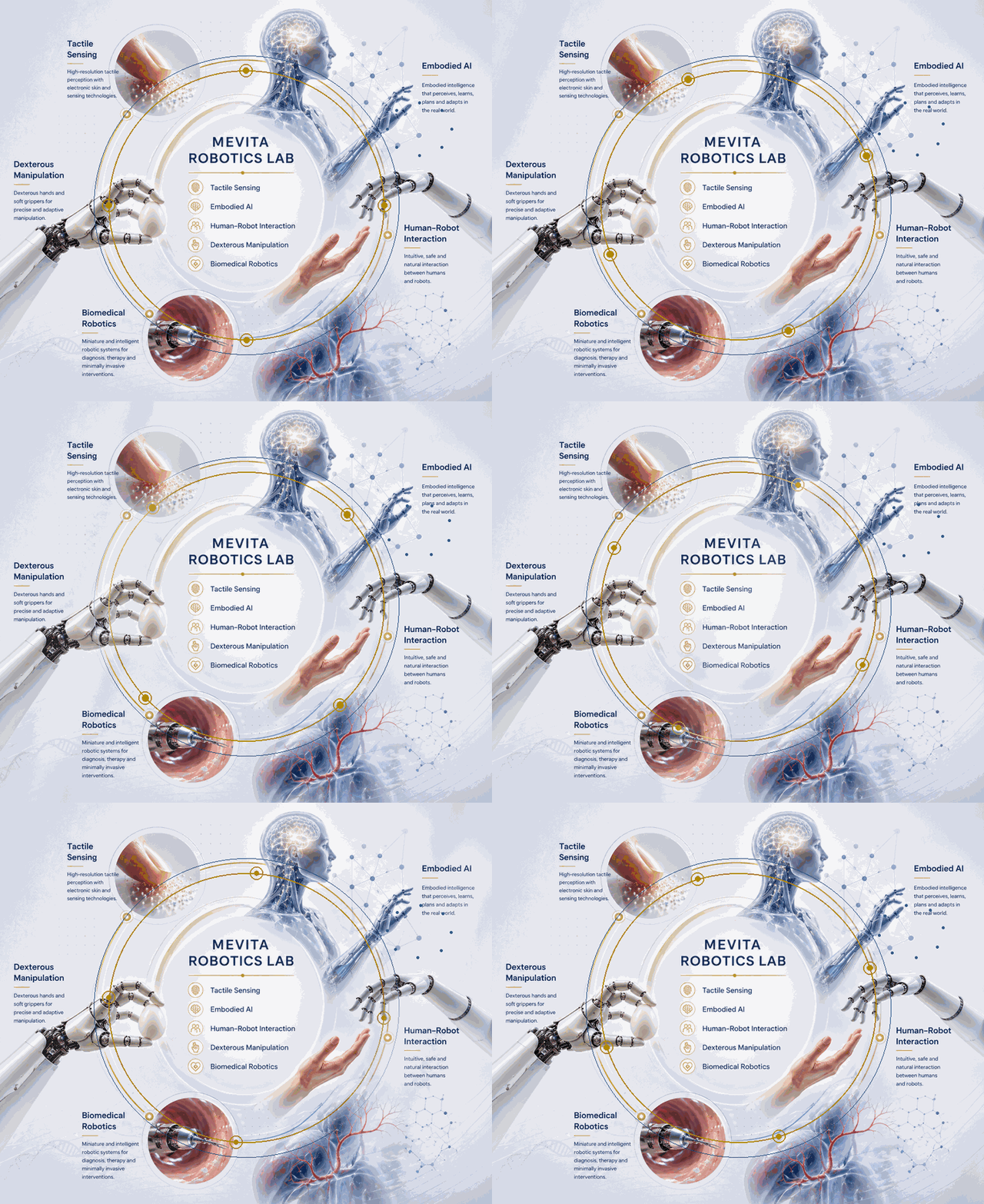
Mevita Robotics Lab

Toward life-like robotic intelligence

We aim to build life-like intelligent robotic agents: systems that can sense, move, interact, learn, and adapt in complex physical environments.

Our research connects tactile perception, embodied dexterity, miniature biomedical robotics, and physical intelligence to create robots that work with the real world — and ultimately with life.

Life-like Intelligence Tactile Perception Embodied Dexterity Miniature Biomedical Robotics
Vision Question

From autonomous instruments to robots — and then to life?

Long before modern robotics, thinkers had already imagined instruments that act by themselves, artificial workers that challenge the meaning of feeling, and small machines that enter the body. These questions continue to shape how we think about robots, intelligence, and life.

Aristotle
Aristotle
4th century BCE
Autonomous instruments
“If every instrument could accomplish its own work, obeying or anticipating the will of others...”
Politics
Aristotle imagined instruments that could act by command or anticipation. It is not yet modern robotics, but it is an early image of automation: tools performing work without direct human labor.
Karel Čapek
Karel Čapek
1920
Robots, pain, and perfection
“Will they be happier when they feel pain?”
“On the contrary; but they will be more perfect from a technical point of view.”
R.U.R.
Čapek’s R.U.R. gave modern culture the word “robot.” Yet the play does not treat robots as mere machines: it asks whether technical perfection can explain feeling, pain, and moral significance.
Richard Feynman
Richard Feynman
1959
Machines, scale, and life
“It would be interesting in surgery if you could swallow the surgeon.”
— “There’s Plenty of Room at the Bottom”
Feynman’s vision was not only about miniature machines; it pointed to a deeper question of scale, matter, and life. When machines become small enough to enter the body, sense, repair, and act with it, they are no longer only external tools. They begin to raise a harder question: can a machine become part of life itself?
What We Do

Toward life-like intelligent robotic agents

Mevita comes from meta and vita — beyond life, or a reflection on what life-like intelligence could become. It captures our vision of building robotic systems that move beyond machines toward life-like sensing, adaptation, and interaction.

The ultimate goal of Mevita Robotics Lab is to create robotic agents that approach life-like intelligence: systems that can sense, move, interact, adapt, and survive in complex physical environments. We pursue this goal through tactile perception, embodied dexterity, and miniature biomedical robotics.

Tactile Perception & Artificial Skin
We develop tactile sensors, artificial skins, soft sensing interfaces, and perception algorithms that allow robots to feel physical contact. For a life-like agent, touch is not an accessory; it is a primary way of knowing the world.
Embodied Dexterity & Robot Manipulation
We study robotic hands, adaptive grasping, dexterous manipulation, and embodied AI methods that connect perception, action, and physical feedback. Intelligence is not only computed; it is formed through interaction with the world.
Miniature & Biomedical Robotics
We design miniature, bioinspired, and intelligent robotic systems for sensing, diagnosis, intervention, and therapy. At small scales, robots begin to interface directly with living systems, raising new possibilities for machines that work with life.
Detailed project descriptions, representative systems, and selected research platforms are available on the Research page.
Explore Research

Contact

Mevita Robotics Lab

Department of Electronic and Computer Engineering, HKUST
Room 2450, Academic Building, Clear Water Bay, Hong Kong
eeyajing@ust.hk